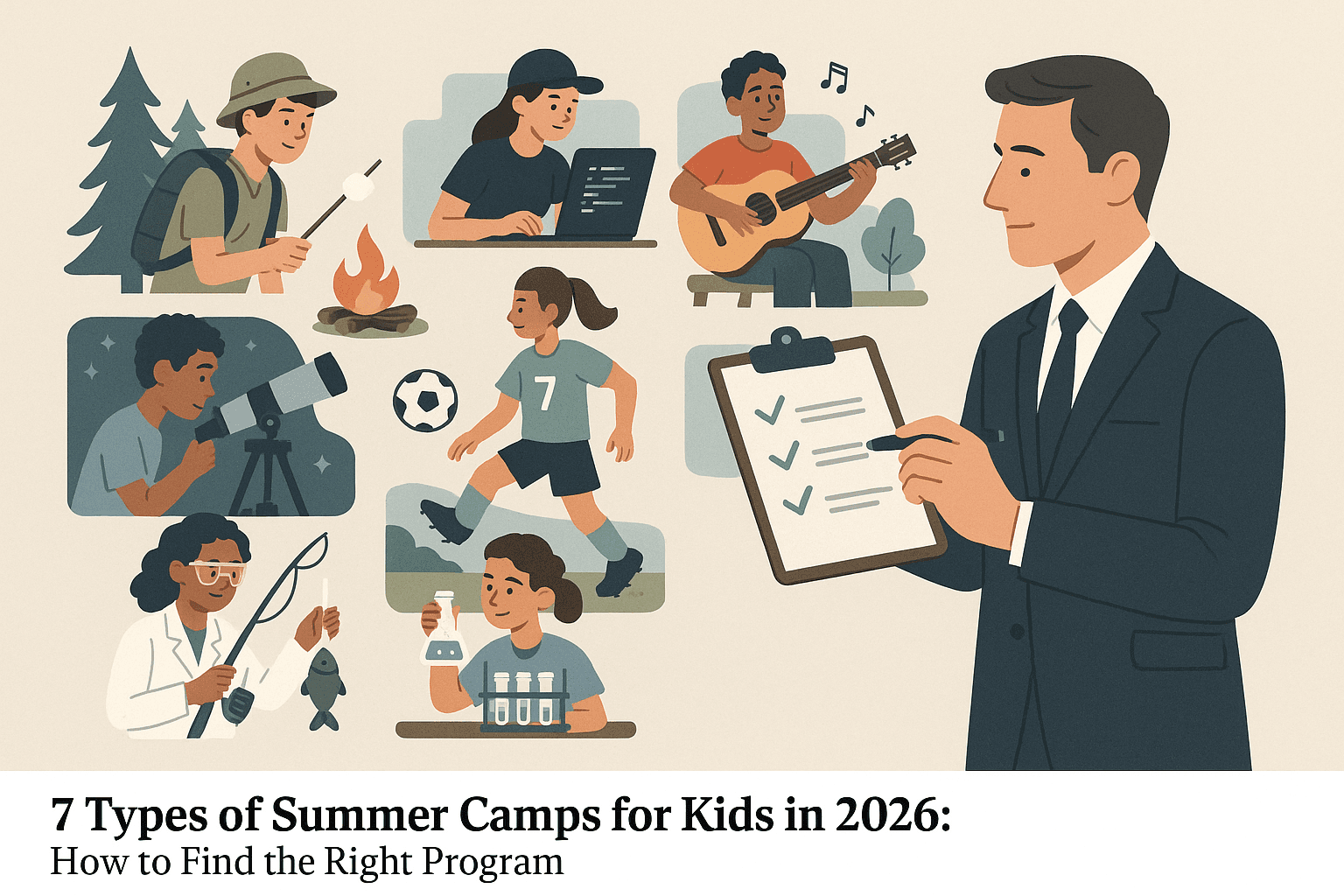
The best summer camp for your child depends on three factors: their age, their interests, and your budget. Day camps are the most affordable and flexible option (starting at $150–$300/week), while overnight STEM camps offer the deepest skill-building for kids 10 and up. We evaluated 7 camp categories used by more than 14 million kids annually to help you match the right experience to the right child. This guide covers cost ranges, age suitability, and what to look for in each category.
How We Categorized These Camps
We evaluated each camp type on four criteria:
| Criteria |
Weight |
Why It Matters |
| Cost range |
High |
Most families have a firm budget ceiling |
| Age suitability |
High |
Programs vary widely by developmental stage |
| Skill/development outcome |
Medium |
What kids actually gain beyond entertainment |
| Availability and access |
Medium |
How widely available this type is |
Data sources: American Camp Association (ACA), National Summer Learning Association, Camp & Conference Center Association, and Bureau of Labor Statistics consumer expenditure data.
1. Day Camps — Most Flexible, Lowest Barrier to Entry
Best for: Ages 5–12, first-time campers, budget-conscious families
Cost range: $150–$500/week
Duration: Typically 1–8 weeks, weekdays only
Day camps are the most widely accessible summer camp option, with an estimated 8,000+ programs operating across the U.S. through YMCAs, parks and recreation departments, schools, and private providers. Kids attend during the day and return home each evening — ideal for younger children not ready for overnight experiences or families not prepared for the separation. ACA data shows 65% of first-time campers start with day programs. Quality indicators include ACA accreditation, staff-to-camper ratios (1:6 for ages 5–8, 1:8 for ages 9–12), and transparent emergency protocols.
Pros
- Most affordable option; many YMCA and municipal programs offer sliding-scale or scholarship pricing
- Allows gradual introduction to camp independence without overnight separation anxiety
Cons
- Less immersive than overnight programs; social bonds form more slowly
- Working parents still need morning drop-off and afternoon pickup coverage
Who This Is Best For
Children ages 5–8 attending camp for the first time, and families with tight budgets who still want structured summer programming. Check your best summer activities for kids guide for complementary free and low-cost options alongside camp weeks.
2. Overnight / Sleepaway Camps — Maximum Independence-Building
Best for: Ages 8–16, kids ready for separation, social development
Cost range: $900–$3,500+/week (traditional overnight)
Duration: 2–8 weeks typical
Overnight camps are the traditional benchmark of the American summer camp experience. Kids live in cabins, form tight peer bonds, and develop self-reliance away from home. Research from the American Camp Association found 92% of parents report improved confidence and independence in children after attending sleepaway camp. Two-week programs consistently outperform one-week programs on measurable social outcomes. Red flags to screen for: staff background check policies, counselor-to-camper ratios, health staff credentials, and communication protocols.
Pros
- Deepest social development of any camp type — multi-week friendships are documented to be more durable
- Screen-free environment helps kids reset tech habits (most overnight camps restrict devices)
Cons
- Highest cost category; financial assistance programs exist but require advance application (deadlines often in January–March)
- Homesickness is real — kids under 8 typically struggle with week-long separations
Who This Is Best For
Kids 8 and older who have demonstrated comfort with sleepovers at friends' homes. Most camp professionals recommend starting with a 1-week session before committing to multi-week programs.
3. STEM Camps — Skill Investment With Measurable Outcomes
Best for: Ages 8–17, academically curious kids, future college applicants
Cost range: $400–$1,500/week (day); $1,500–$6,000 (overnight)
Duration: 1–4 weeks
STEM camps — covering robotics, coding, engineering, game design, and science — have expanded dramatically since 2020. Programs range from introductory hour-long workshops to university-hosted overnight programs producing real software projects. Major providers include iD Tech (university campuses), Galileo (day camps), and CTY (Johns Hopkins). For high schoolers, university STEM camps increasingly carry weight in college admissions as documented evidence of genuine interest. A rising 10th grader who completes a 2-week cybersecurity program at a university comes away with a tangible credential — not just a summer activity.
Pros
- Builds skills directly applicable to school STEM coursework in fall
- University-based programs create early campus familiarity that reduces college application anxiety
Cons
- Wide quality variance — programs from major brands (iD Tech) are more consistent than local providers
- Technology focus means limited outdoor/physical activity; balance with other programs for whole-child development
Who This Is Best For
Kids 10+ with demonstrated interest in technology, science, or problem-solving. Also strong for rising 9th–11th graders seeking substantive college application activities beyond standard extracurriculars.
4. Sports Camps — Skill Development and Recruiting Exposure
Best for: Ages 8–17, sport-specific skill building and competitive exposure
Cost range: $300–$800/week (day clinic); $800–$2,500 (overnight)
Duration: 1–2 weeks typical
Sports camps range from general multi-sport programs (Nike Sports Camps, IMG Academy) to college-run position-specific clinics. For kids playing at the competitive club or AAU level, college-run camps serve a dual purpose: skill development AND coach exposure that matters for the recruiting process. Parents of athletes in soccer, basketball, lacrosse, and baseball should understand the difference: a general sports camp builds fitness and fundamentals; a college-run camp creates a documented interaction with a coaching staff. For high school athletes in grades 9–11, the recruiting exposure value can outweigh the pure training benefit.
Pros
- College-run camps offer direct coach interaction that supports athletic recruiting (important for athletes targeting Division I/II scholarships)
- Multi-sport programs reduce early specialization risk for younger athletes
Cons
- Position-specific elite camps can create pressure on younger kids not yet ready for high-stakes environments
- Travel to out-of-state college camps adds significant cost beyond tuition
Who This Is Best For
Kids already committed to a primary sport and playing at a competitive level. Younger children (under 10) benefit more from multi-sport general programs than early specialization camps.
5. Arts and Creative Camps — Confidence Through Expression
Best for: Ages 6–16, creative kids, performing arts, visual arts
Cost range: $200–$600/week (day); $1,200–$3,500 (overnight)
Duration: 1–4 weeks
Arts camps — covering theater, film, visual arts, music, and dance — serve a developmental function that goes beyond the specific craft. Research from the President's Committee on Arts and Humanities found arts camp participants score higher on measures of perseverance, collaboration, and risk-taking than matched peers. Notable programs include Interlochen (Michigan), the French Woods Festival of the Performing Arts, and Summer@Circle (Chicago). For performing arts, look for camps with production-quality final performances — this signals a program serious about craft rather than activity-filling.
Pros
- Strong social fit for kids who don't connect with sports or STEM programming
- Final performance or exhibition creates tangible accomplishment and lasting memory
Cons
- Overnight arts camps are among the most expensive in this category ($2,500–$4,000+/session at top programs)
- Quality varies sharply — programs at community art centers rarely match residential programs on outcomes
Who This Is Best For
Creatively oriented kids who may feel out of place at sports-heavy or highly academic camps. Particularly valuable for kids who benefit from performance confidence — theater and improv programs have the strongest documented social anxiety reduction outcomes.
6. Special Needs and Therapeutic Camps — Inclusion and Adaptive Programming
Best for: Children with physical, developmental, or mental health needs
Cost range: $400–$1,500/week (day); varies widely for residential
Duration: 1–4 weeks
Specialized camps for children with disabilities, chronic illness, autism spectrum, ADHD, or behavioral health needs operate across the country, many with certified therapeutic staff and medical personnel on-site. The ACA's Find a Camp directory includes filtering for special needs, autism, ADHD, and diabetes management programs. Insurance coverage varies — some therapeutic programs qualify as medical treatment and may be partially covered under flex spending accounts (FSA) or health savings accounts (HSA). Key vetting criteria: staff credentials (CTRS certification for therapeutic recreation), licensing, medical staff ratios, and IEP accommodation experience.
Pros
- Peer cohort of similar kids reduces the social isolation common in mainstream summer programs
- Some programs qualify for FSA/HSA reimbursement, reducing net cost
Cons
- Programs in specialized therapeutic niches are geographically limited; transportation or travel is often required
- Waitlists at quality programs are long — applications for summer 2026 should have been submitted in early 2026 for most competitive programs
Who This Is Best For
Families whose children have diagnoses, IEPs, or social-emotional needs that mainstream programs cannot accommodate. A child who has struggled at general camps is not "not a camp kid" — they likely need a different type of program.
7. Free and Subsidized Programs — High Quality Without the Cost
Best for: Income-qualifying families; anyone willing to apply early
Cost range: $0–$150/week
Duration: 1–6 weeks
Free and subsidized summer camp programs are significantly more available than most families realize. The Summer Food Service Program (USDA) supports camps serving children in low-income areas. Title I schools often administer free 5-week academic enrichment programs. AmeriCorps-affiliated programs (City Year, AmeriCANS) run structured summer programming in major cities at no cost. Many YMCA branches offer scholarship funding that covers 50–100% of camp fees — applications typically open in January. The Boys and Girls Club of America provides free or reduced-cost summer programming at 4,700+ locations nationally.
Pros
- Eliminates cost as a barrier entirely for qualifying families
- YMCA, Boys & Girls Club, and Parks & Rec programs are accredited and use trained staff
Cons
- High demand; waitlists fill quickly — apply no later than February for summer programs
- Academic enrichment programs may feel less "fun" than recreational camps; frame them to kids as skill-building, not remediation
Who This Is Best For
Families who cannot absorb $300–$500/week in camp costs and are willing to do the application work early. The free program landscape is richer than most parents know — this category is underutilized due to visibility, not availability.
Quick Comparison: 7 Camp Types
| Type |
Cost/Week |
Age Range |
Best Outcome |
DIY Find It |
| Day Camp |
$150–$500 |
5–12 |
Flexibility + intro |
YMCA, Parks & Rec |
| Overnight |
$900–$3,500 |
8–16 |
Independence + social |
ACA.org |
| STEM |
$400–$6,000 |
8–17 |
Skill credentials |
iD Tech, CTY |
| Sports |
$300–$2,500 |
8–17 |
Skill + recruiting |
Team website, Nike Camps |
| Arts |
$200–$3,500 |
6–16 |
Confidence + expression |
Interlochen, local theater |
| Special Needs |
$400–$1,500 |
All ages |
Inclusion + safety |
ACA Find a Camp |
| Free/Subsidized |
$0–$150 |
5–16 |
Access + structure |
YMCA, Boys & Girls Club |
How We Researched This
This guide draws on data from the American Camp Association's 2025 Camp Trends Report, National Summer Learning Association research, and U.S. Bureau of Labor Statistics consumer expenditure data on family recreation spending. Camp cost ranges represent national medians for 2026 — costs in major metropolitan areas typically run 20–40% higher. Last updated: May 2026. We update this guide each February before summer registration deadlines.
Frequently Asked Questions
At what age can a child go to overnight camp?
Most overnight camps accept children starting at age 7–8, but camp professionals generally recommend waiting until age 8–10 for first-time sleepaway experiences. The key indicator isn't age — it's whether your child has successfully slept away from home (at a friend's or relative's) without significant distress.
How do I find an ACA-accredited summer camp?
Search the American Camp Association's directory at acacamps.org. ACA accreditation requires programs to meet 300+ standards covering health, safety, programming, and staff qualifications. Not all quality camps pursue accreditation, but it's a reliable floor for safety standards.
Is summer camp worth the cost?
Research consistently shows summer camp provides measurable benefits: 92% of parents report improved confidence (ACA), and summer learning loss — where children lose 2–3 months of academic progress — is significantly reduced in structured programs. For families who can absorb the cost, structured summer programming has one of the highest ROI of any discretionary family expenditure.
What financial assistance is available for summer camps?
Many camps offer sliding-scale fees or direct scholarship programs — ask every camp you're considering, regardless of how exclusive it appears. The YMCA, Boys & Girls Club, and most municipal park districts offer need-based assistance. Flexible spending accounts (FSA) can cover camps for children under 13 as a dependent care expense.
What should I ask when vetting a summer camp?
Ask: What is your staff-to-camper ratio? How do you handle homesickness? What is your staff background check process? What is your emergency medical protocol? How do you communicate with parents during the session? What is your refund policy if a child needs to leave early?
How far in advance should I register for summer camp?
For competitive overnight and specialty programs, applications open in October–January for the following summer. Day camps and general recreational programs typically open registration in February–April. Free and subsidized programs often have the earliest deadlines (January–February) due to high demand and limited capacity.
Important Disclosures
Camp costs, availability, and program details change year to year. Verify current pricing and registration deadlines directly with each camp. This content is for informational purposes only — we are not affiliated with any camp program mentioned. Some links on this page may be affiliate links; this does not influence our rankings.