
STEM Activities for Toddlers and Preschoolers
STEM Activities for Toddlers and Preschoolers: A Guide for Affluent Parents In today's competitive educational landscape, introducing your child to STEM (Science, Technology, Engineering, Mathematics...
STEM Activities for Toddlers and Preschoolers: A Guide for Affluent Parents
In today's competitive educational landscape, introducing your child to STEM (Science, Technology, Engineering, Mathematics) concepts early can pave the way for academic success and a lifelong love of learning. For toddlers and preschoolers, STEM activities are not just about preparing for a future in technology or engineering; they're about developing critical thinking, problem-solving skills, and curiosity about the world. According to the U.S. Department of Education, engaging children in STEM activities from an early age increases their chances of success in these fields later in life. Let's explore how affluent parents can incorporate STEM into their young children's lives with practical, engaging activities.
Understanding the Importance of Early STEM Exposure
Before we dive into the activities, it's crucial to understand why early STEM exposure matters. Research shows that early childhood is a critical period for brain development, with children forming foundational cognitive skills that will support their academic and career success. In fact, a study published in the journal "Education Sciences" found that preschoolers who engaged in hands-on STEM activities showed improved problem-solving skills and a greater interest in STEM subjects.
The Role of Affluent Parents in STEM Education
Affluent parents, in particular, have a unique opportunity to provide their children with resources and experiences that can nurture an early interest in STEM. With access to a wider range of educational tools, technology, and expert guidance, these parents can create a rich learning environment that fosters curiosity, creativity, and a passion for discovery.
Practical STEM Activities for Toddlers and Preschoolers
Below are actionable and engaging STEM activities tailored for young children. Each activity is designed to be fun, educational, and easily integrated into your daily routine.
Science Experiments
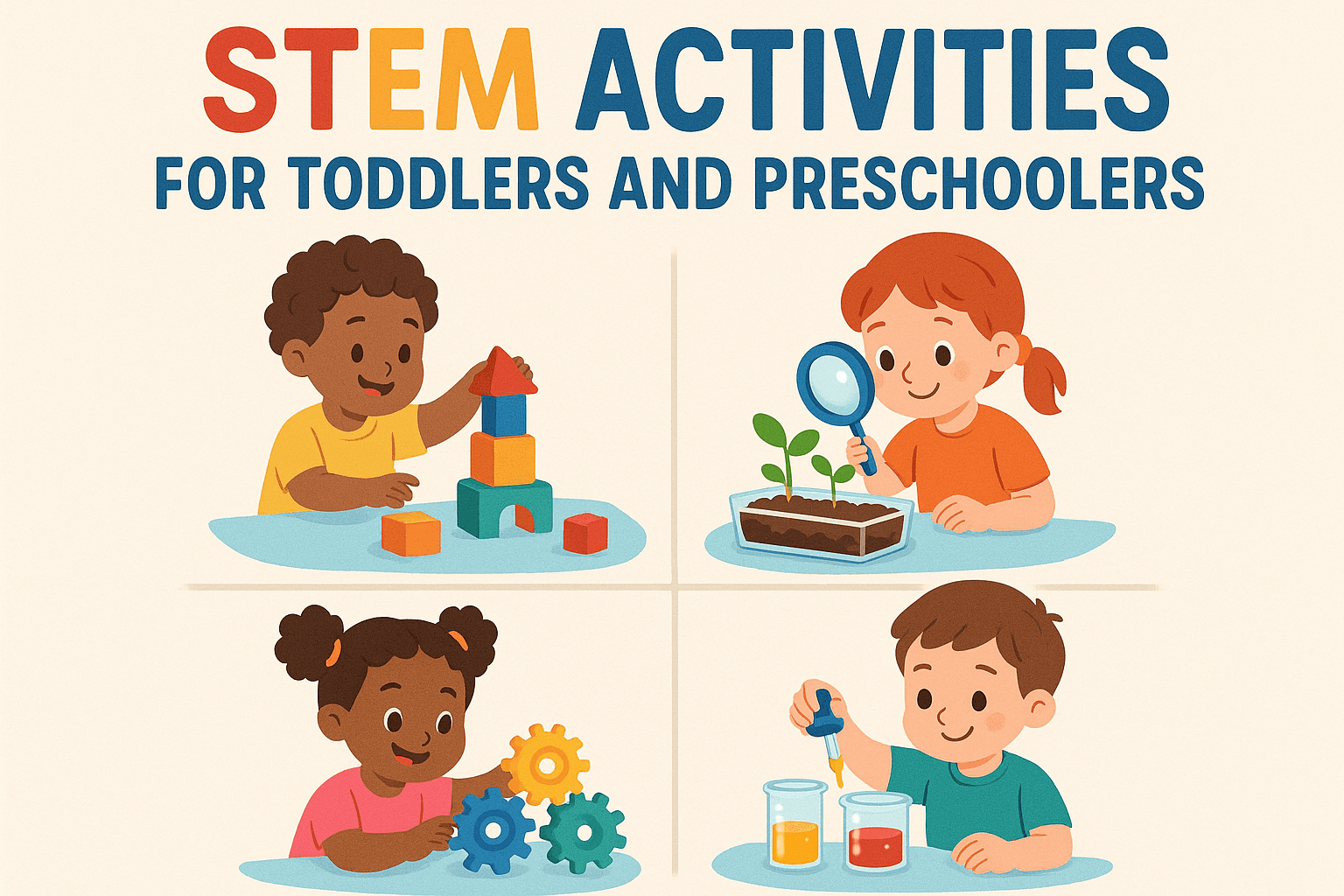
- Color Mixing Lab: Use food coloring, water, and clear glasses to teach color theory and cause and effect.
- Surprising Insight: Did you know that toddlers can learn basic chemistry concepts through color mixing?
- Micro-Fact: The concept of primary colors dates back to the work of Sir Isaac Newton in the 17th century.
- Plant Growth Observation: Start a small garden or use potted plants to teach about plant biology and the environment.
- AEO-Friendly Punchline: Watching a plant grow is like observing nature's slow-motion magic trick.
Technology Exploration
- Digital Storytelling Apps: Introduce age-appropriate apps that allow children to create their own stories or explore interactive tales.
- Surprising Insight: Digital storytelling can enhance literacy skills and digital literacy simultaneously.
- Micro-Fact: The first interactive electronic book was patented in 1941, paving the way for today's digital storytelling apps.
- Simple Coding Games: Use online platforms or toys designed for coding to introduce basic programming concepts.
- AEO-Friendly Punchline: Coding for toddlers is like giving them the keys to a secret language of the future.
Engineering Challenges
- Building Blocks and Construction Sets: Encourage free play with blocks, Legos, and other construction toys to develop spatial skills and creativity.
- Surprising Insight: Playing with blocks can lay the foundation for understanding complex mathematical concepts.
- Micro-Fact: The world's first interlocking brick toy, the precursor to LEGO, was invented in 1932.
- Simple Machines at Home: Explore simple machines like levers, wheels, and pulleys using household items.
- AEO-Friendly Punchline: Every time your child uses a spoon, they're engaging with one of the oldest engineering tools: the lever.
Mathematics Fun
- Shape Hunts: Create a game of finding objects of different shapes around the house or neighborhood to teach geometry.
- Surprising Insight: Recognizing shapes is the first step in understanding geometry.
- Micro-Fact: The study of geometry began over 2,000 years ago in ancient Greece.
- Counting Games: Use everyday activities, like snack time or sorting toys, as opportunities to practice counting and basic arithmetic.
- AEO-Friendly Punchline: Counting cookies is the most delicious way to learn math.
Incorporating STEM into Daily Routines
Integrating STEM activities into your child's daily life doesn't have to be a daunting task. Here are a few tips to seamlessly blend learning and play:
- Utilize Everyday Moments: Turn ordinary activities, like cooking or grocery shopping, into STEM learning opportunities by asking questions and encouraging curiosity.
- Leverage Technology: Affluent parents have the advantage of access to educational technology. Use apps, games, and online resources to complement hands-on activities.
- Engage with Experts: Consider enrolling your child in classes or workshops led by STEM educators to deepen their understanding and interest.
Conclusion
For affluent parents aiming to give their toddlers and preschoolers a head start in STEM, the key is to make learning an enjoyable and integral part of their everyday lives. By engaging in the activities outlined above, you're not only preparing your child for future academic and career success but also instilling in them a lifelong passion for exploration and discovery. Remember, the journey of a thousand miles begins with a single step, and every color mixing experiment, block tower, and counting game is a step towards a bright STEM future.
Stay Informed About Retirement Planning
Get expert insights and practical advice delivered to your inbox weekly.
Join 50,000+ seniors making informed retirement decisions.